
WEBSITES FOR PUBS AND RESTAURANTS
Found before the table is booked: website design for pubs, restaurants and cafés in Sussex
Menu, hours and a table, all checked on a phone before anyone sets off. A site that gets those three right and answers the party enquiry while you are on service.
Where the covers come from
Three searches that end in a booking
A pub or a restaurant is chosen in the few minutes between someone being hungry and someone booking. The site has to survive that, on a phone, with one hand. It is one of the sector pages under websites, one per trade; for a business with a booking diary and no kitchen, the hair salon page covers chairs, deposits and no-shows.
The search on the way somewhere
Somebody in a car or on a walk searches for food near where they are, or for a roast on a Sunday, and picks from the map. Whether the kitchen is open right now decides it, and that answer has to be correct.
The menu check
Nobody books a table without reading the menu first, usually on a phone at the kitchen table at home. A menu that will not load, or lives in a PDF the phone cannot read, sends them to the pub down the road.
The occasion
Birthdays, the work Christmas do, a wake, a table for twelve on a Saturday. These are the bookings worth the most and they arrive by email with three questions attached, weeks ahead, when nobody has time to answer them.
A pub build
One from the village
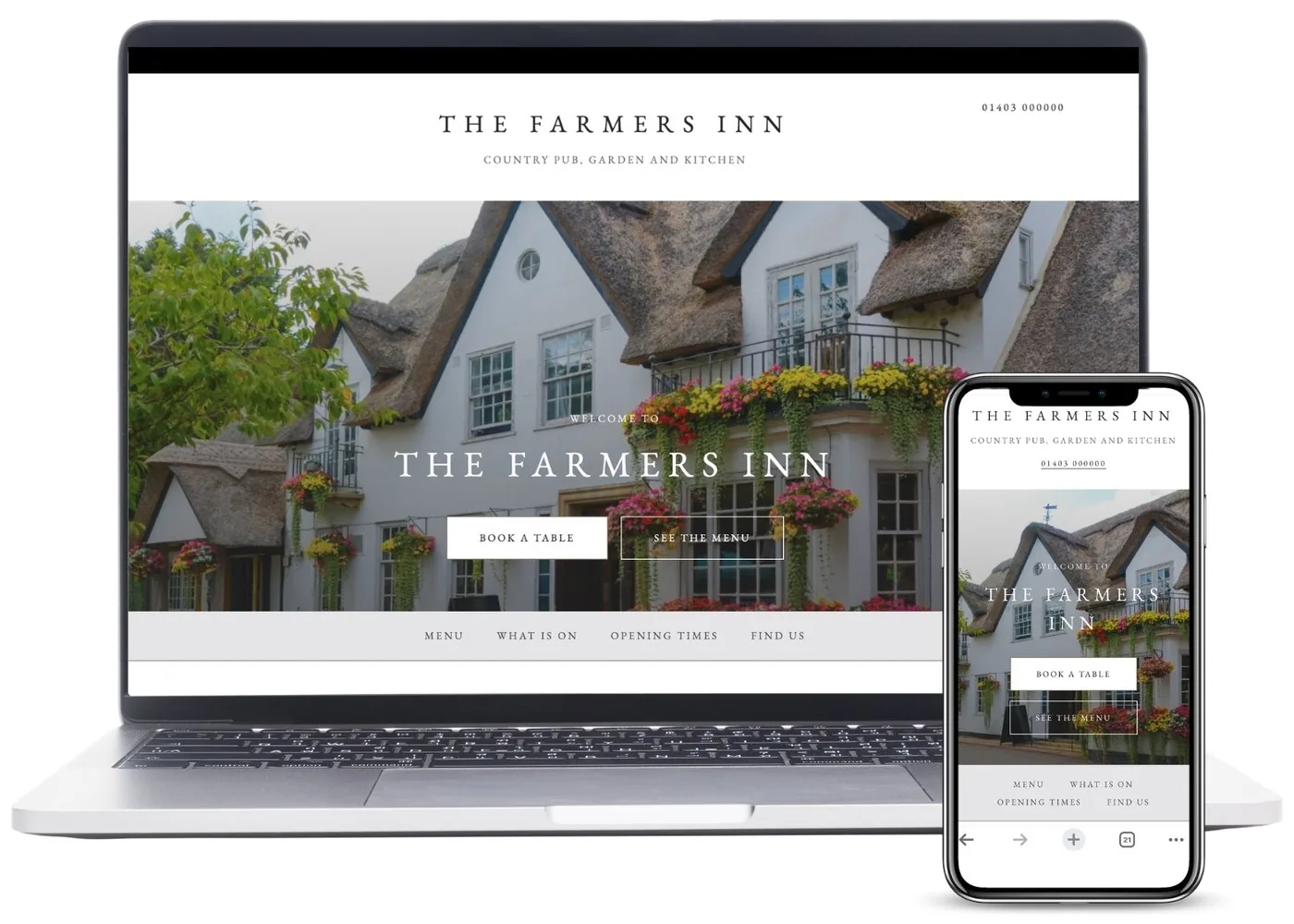
This build had to offer the table and the menu on the first screen, above a photograph of the building itself, because for a country pub the building is half the reason people come.
What the site has to do
Menu, hours, table, in that order
The usual pub site
What this one does instead
The menu as a photograph or a PDF, unreadable on a phone and invisible to Google.
The menu as text on the page, with the dishes, the prices and the allergens, so it loads on a phone in the car park and can be found by someone searching for the dish.
Opening hours copied from last year, and a kitchen that stops an hour earlier than the door.
Bar hours and kitchen hours shown separately and kept in one place, so the site and the Google listing never disagree about whether you are serving.
Book a table by ringing during service.
A table booked from the site, either into the booking system you already run or into a diary built into the site, with the size of party and the occasion asked up front.
What's on this month, updated by whoever remembers.
Quiz night, live music and the seasonal menu on a page that is easy to change from a phone, because a stale events page is worse than none.
Photographs of an empty room taken on opening day.
Photographs of the food, the garden and the room with people in it, sized so the page still opens quickly on the signal outside a village pub.
The function enquiry answered from the till when service allows.
A form for parties and functions that asks the date, the numbers and the budget, so the reply can be written before you have opened the email.
After the enquiry lands
Cover found, party confirmed
The first card is the line Glo has already written for hospitality. The other two are written for this page and describe what the same tools do for a kitchen and a front of house. A person ticks everything before it sends.
A sickness text at seven in the morning arrives with three names who can cover the shift.
An email asks about a Christmas party for thirty. The date, the numbers and the question about a set menu are read out of it, and a reply with the right menu and the deposit terms is drafted for you to check between services.
A table for ten on Saturday gets a text on Friday with a link. One tap confirms, one tap changes the numbers, and a party that was never going to turn up is released while the table can still be sold.
What it costs
Standard for most kitchens
A menu, hours, photographs and a link into the booking system you already use is a Standard build. A booking diary inside the site, or a function-enquiry system that writes its own replies, is Advanced and quoted after a scoping call. The person doing the work is the founder, who has run businesses of his own and does the build personally.
The three grades, with what each includes, are printed on the pricing page
Questions publicans ask
Before you change anything
On the page, as text. A PDF is hard to read on a phone, cannot be searched by Google for the dishes on it, and is usually out of date because changing it means a designer. Text on the page can be changed from a phone in the time it takes to tell a customer.
Yes. If you already run a booking system, the site sends people into it and that is a Standard build. If you do not, a diary built into the site with party size and occasion asked up front is what the Advanced grade covers.
No, unless you want it to. The site links straight into the system you run, and where that system has an open connection the bookings can be read from it so the site and the app never disagree. Replacing it is a separate decision for a separate day.
They are read as they arrive, the date and numbers are pulled out, and a reply with the right menu and your deposit terms is drafted in your wording. It sends when somebody has ticked it, which can be at eleven at night after the last table has gone.
Yes. A sickness text at seven in the morning is recorded, the rota is checked, and the message that reaches you carries the names of who is free and qualified to cover the shift. You choose; it asks.
Next step
An hour before service
Bring the function enquiries from the last month and the no-shows from the last fortnight, and we will look at what a site that reads the menu, the hours and the diary properly would have done with each of them.